Turn over a bar of French soap and you will find a long line of names like Sodium Palmate, Butyrospermum Parkii and CI 77891. It looks like a chemistry quiz, but it follows a few simple rules. Once you know them, you can read any soap label in under a minute. Here is how, using the label on our own bars as the example.
Why European soap labels look like this
Soap sold in Europe lists its ingredients in a system called INCI, short for International Nomenclature of Cosmetic Ingredients. Every ingredient has one standard name, so a bar made in France, Italy or Germany uses the same words. Plant ingredients usually appear under their Latin botanical names, with the common name in parentheses.
Two rules make the list easy to read:
- Order means amount. Ingredients are listed from the largest amount to the smallest. Anything under 1% can appear in any order at the end.
- Everything is named. Fragrance appears as one word, Parfum, but certain fragrance compounds above a set level must be named separately.
The US is different. A bar that is true soap and is sold only for cleaning is not covered by the cosmetic labeling rules, so plenty of American bars have no ingredient list at all. That makes a full European label a useful thing to have when you are comparing bars.
Reading a real label, line by line
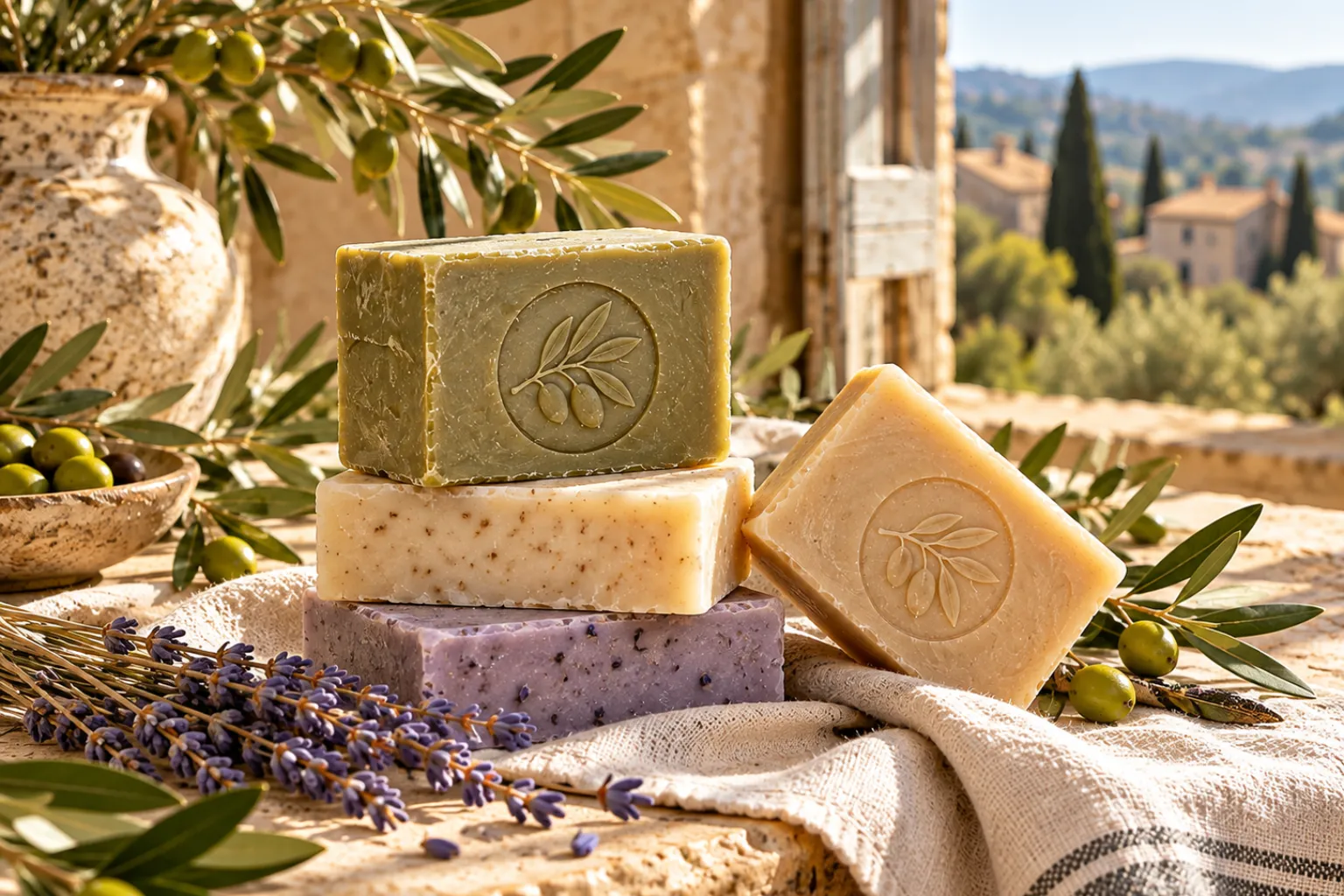
Here is the label from our Lavender bar, made in Provence, France:
Sodium Palmate, Sodium Palm Kernelate, Aqua (Water), Parfum (Fragrance), Palm Kernel Acid, Butyrospermum Parkii (Shea) Butter, Glycerin, Olea Europaea (Olive) Fruit Oil, Sodium Chloride, Tetrasodium EDTA, Tetrasodium Etidronate, Aluminum Hydroxide, CI 73360, CI 77007, CI 77891, Silica
Let's take it in groups.
The soap itself: Sodium Palmate and Sodium Palm Kernelate
Soap is what you get when a fat or oil reacts with an alkali. In bar soap, the alkali is sodium hydroxide, also called lye. The reaction is called saponification, and it turns each oil into a "sodium" version of itself. That is why the names change:
| Oil | Name once it becomes soap | What it brings to a bar |
|---|---|---|
| Palm oil | Sodium Palmate | A hard bar that holds its shape |
| Palm kernel oil | Sodium Palm Kernelate | Quick, fluffy bubbles |
| Coconut oil | Sodium Cocoate | Big, airy lather |
| Olive oil | Sodium Olivate | A dense, creamy lather |
| Beef fat (tallow) | Sodium Tallowate | A hard, long-lasting bar, common in US drugstore soap |
So when you see Sodium Palmate first and Sodium Palm Kernelate second, you are looking at a classic palm-based soap. This pairing is the standard base for French milled soap: one gives a firm bar, the other gives lather. No lye is left in a finished bar; it is used up in the reaction.
A label with Sodium Olivate near the top tells you olive oil is a main oil in the soap base, as in Castile or traditional Marseille soap. Ours is not that kind of bar. If you want the difference explained, read Castile vs. Marseille soap.
Water, fragrance and Palm Kernel Acid
Aqua is water. Every bar holds some, even after it is dried and pressed. Parfum is the fragrance blend that gives each bar its scent. Its position, fourth on our label, tells you there is a fair amount of it, which is why a French bar can scent a whole bathroom. Palm Kernel Acid is a free fatty acid from palm kernel oil, added to round out the lather.
Shea butter, glycerin and olive oil
Butyrospermum Parkii is shea butter, a fat from the nut of the African shea tree. On our labels it carries an asterisk, which matches a footnote on the label. Glycerin forms naturally during saponification and is also added to many recipes. Olea Europaea Fruit Oil is olive oil. Our bars are made with AOP olive oil, olive oil from a protected place of origin, and the label tells you honestly how much: it sits after shea and glycerin, so it is part of the recipe, not the base.
Salt and the "keep it fresh" group
Sodium Chloride is ordinary salt. Soap makers use it to firm up the bar and to separate the soap during making. Tetrasodium EDTA and Tetrasodium Etidronate bind the minerals in water, which helps keep a bar from turning spotty or developing an off smell over time. You will find them in most milled bars.
Color: CI numbers, Silica and Aluminum Hydroxide
CI stands for Color Index. Each number is one colorant:
- CI 77891: titanium dioxide, a white mineral pigment
- CI 77007: ultramarine, a blue mineral pigment
- CI 77491, 77492, 77499: iron oxides, red, yellow and black
- CI 77288: chromium oxide green
- CI 73360: a red colorant, here used as a "lake"
A lake is a dye fixed onto a mineral base so it does not bleed, and that base is often Aluminum Hydroxide or Alumina. Silica and Magnesium Oxide are fine mineral powders that often come along with pigments. Mix ultramarine blue with a little red and white and you get the soft purple of a lavender bar. Our Donkey Milk bar, by contrast, lists only one colorant: CI 77891, white.
The names that follow the colors: fragrance allergens
Many of our labels end with words like Linalool, Limonene, Citral, Geraniol, Coumarin or Eugenol. These are aroma compounds that appear in lots of fragrances and in plants: linalool in lavender, limonene in citrus peel, coumarin in tonka beans and fresh hay. European rules list a set of these compounds that must be named when they pass a certain level, so anyone who wants to avoid one can find it. Seeing them on a label is a disclosure, not a warning. Our Olive Oil bar, for example, lists eight of them; our plain Lavender lists none.
Real botanicals and the preservatives that come with them
Some bars contain real plant material, and the label says so in Latin:
- Crushed Lavender: Lavandula Angustifolia (Lavender) Flower
- Apricot Scrub: Prunus Armeniaca (Apricot) Seed Powder
- Lemon Scrub: Triticum Vulgare (Wheat) Bran
- Herbes de Provence Scrub: basil, marjoram, rosemary, savory and thyme leaf
Bars with plant pieces often add a preservative such as Phenoxyethanol or Benzyl Alcohol, because plant material can spoil in a bar without one. That is a sign of real botanicals, not a mark against the soap. Our guide to exfoliating bar soap covers every scrub bar's particles.
What a label can't tell you
A label tells you what is in the bar, roughly how much, and where the color and scent come from. It doesn't tell you how a scent smells, how firm the bar is, or how long it lasts on your sink. For that, read the scent notes, and keep the bar on a dish that drains between uses.
A few words to read carefully on any brand's packaging:
- "Natural" has no legal definition for soap in the US. Read the ingredient list instead.
- "Unscented" and "fragrance-free" are not always the same. Check whether Parfum appears on the list.
- "Beauty bar" or "cleansing bar" often means a synthetic detergent bar, not soap. Look for names like Sodium Lauroyl Isethionate at the top instead of a "sodium" oil.
Quick reference
| On the label | In plain English |
|---|---|
| Sodium Palmate | Palm oil soap |
| Sodium Palm Kernelate | Palm kernel oil soap |
| Aqua | Water |
| Parfum | Fragrance |
| Butyrospermum Parkii Butter | Shea butter |
| Olea Europaea Fruit Oil | Olive oil |
| Sodium Chloride | Salt |
| Tetrasodium EDTA | Binds water minerals, keeps the bar fresh |
| CI + five digits | A colorant |
| Linalool, Limonene, Citral | Named fragrance compounds |
Every soap page on our site shows that bar's full ingredient list, so you can compare before you build a set. To see how the soap base itself is made, read how soap is made.
Questions
What is sodium palmate?
Sodium palmate is palm oil that has been turned into soap. When an oil reacts with sodium hydroxide (lye), it becomes a sodium salt of its fatty acids, and that salt is the soap. Sodium palmate gives a bar its hardness and helps it hold its shape in the shower.
What is sodium palm kernelate?
It is palm kernel oil, pressed from the seed of the palm fruit, turned into soap. It makes quick, fluffy bubbles, which is why it is often paired with sodium palmate in classic bars.
Why does a soap label list linalool, limonene or coumarin?
They are aroma compounds found in many fragrances and in plants like lavender and citrus. European rules require certain ones to be named on the label when they pass a set level, so people who want to avoid a specific one can spot it. It is a labeling rule, not a warning.
What do the CI numbers on a soap label mean?
CI stands for Color Index, an international numbering system for colorants. CI 77891 is titanium dioxide (white), CI 77007 is ultramarine (blue), and CI 77491, 77492 and 77499 are iron oxides (red, yellow and black).
Do soaps sold in the US have to list ingredients?
Not always. In the US, a bar that is true soap and is sold only for cleaning falls outside the cosmetic labeling rules, so many American bars carry no ingredient list. Soap made for the European market lists every ingredient by its INCI name.