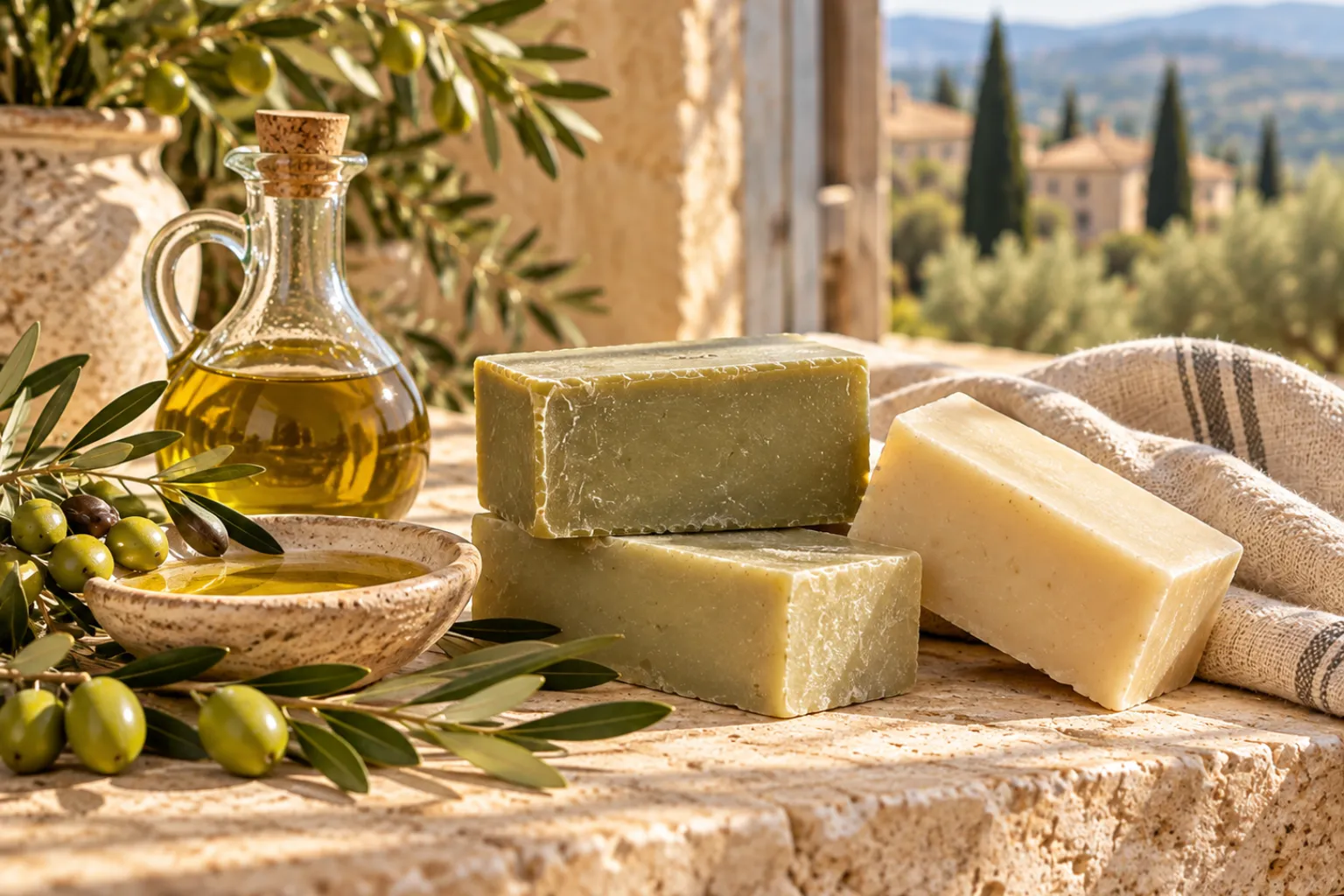
Castile soap and Marseille soap are two of the oldest names in soap, and both come back to the same tree: the olive. They are often mixed up, and both names now appear on products that have little to do with the originals. Here is what each one really is, how they differ, and what to look for on the label.
A family of Mediterranean olive oil soaps
For most of history, soap was made from whatever fat was close at hand. In northern Europe that often meant animal fat. Around the Mediterranean it meant olive oil. Several famous soaps grew out of that:
| Soap | Where | What defines it |
|---|---|---|
| Aleppo soap | Syria | Olive oil with laurel berry oil, aged for months |
| Castile soap | Spain | Made mostly or entirely from olive oil |
| Savon de Marseille | France | Cooked in large kettles, about 72% oil, sold as a plain cube |
Each one tells you something different. Castile is about the oil. Marseille is about the method. That's the simplest way to keep them apart.
What is Castile soap?
Castile is a historic region in the middle of Spain. In the Middle Ages, soap makers there and in nearby regions made a hard, pale soap from local olive oil. It was prized across Europe, and "Castile" became shorthand for a fine olive oil soap.
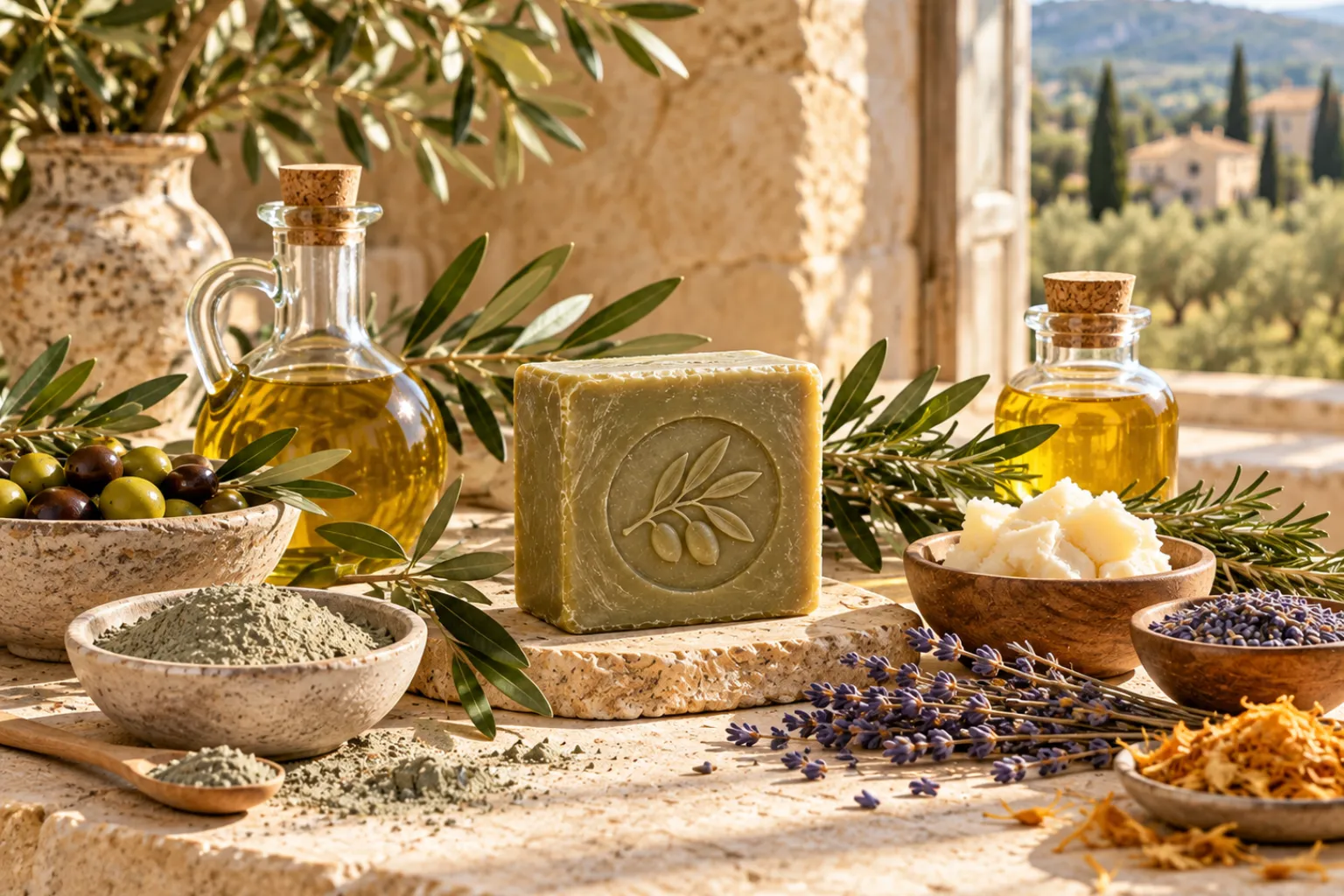
In the traditional sense, Castile soap is soap made mostly or entirely from olive oil. On an ingredient list, olive oil that has been turned into soap shows up as sodium olivate in a bar, or potassium olivate in a liquid.
Castile soap in the US today
In American stores, "Castile" usually means something broader: any soap made from plant oils, with no animal fat. Many of the best known products are liquid, and many use coconut, hemp or other oils alongside or instead of olive oil. That isn't wrong, since the name has no legal definition, but it does mean "Castile" on a bottle doesn't tell you much by itself. The ingredient list does.
How Castile soap lathers
A bar made only from olive oil gives a low, creamy lather with small bubbles. It can feel a bit slick, and it takes a long cure to get hard. That's why many makers add coconut oil, which brings bigger, quicker bubbles. Once they do, the bar is no longer pure olive oil soap, even if it's still sold as Castile.
What is Savon de Marseille?
Savon de Marseille is the classic soap of Marseille, the port city of Provence. In 1688, an edict under Louis XIV set rules for soap made there, including that it be made with olive oil. The city became one of Europe's great soap centers.
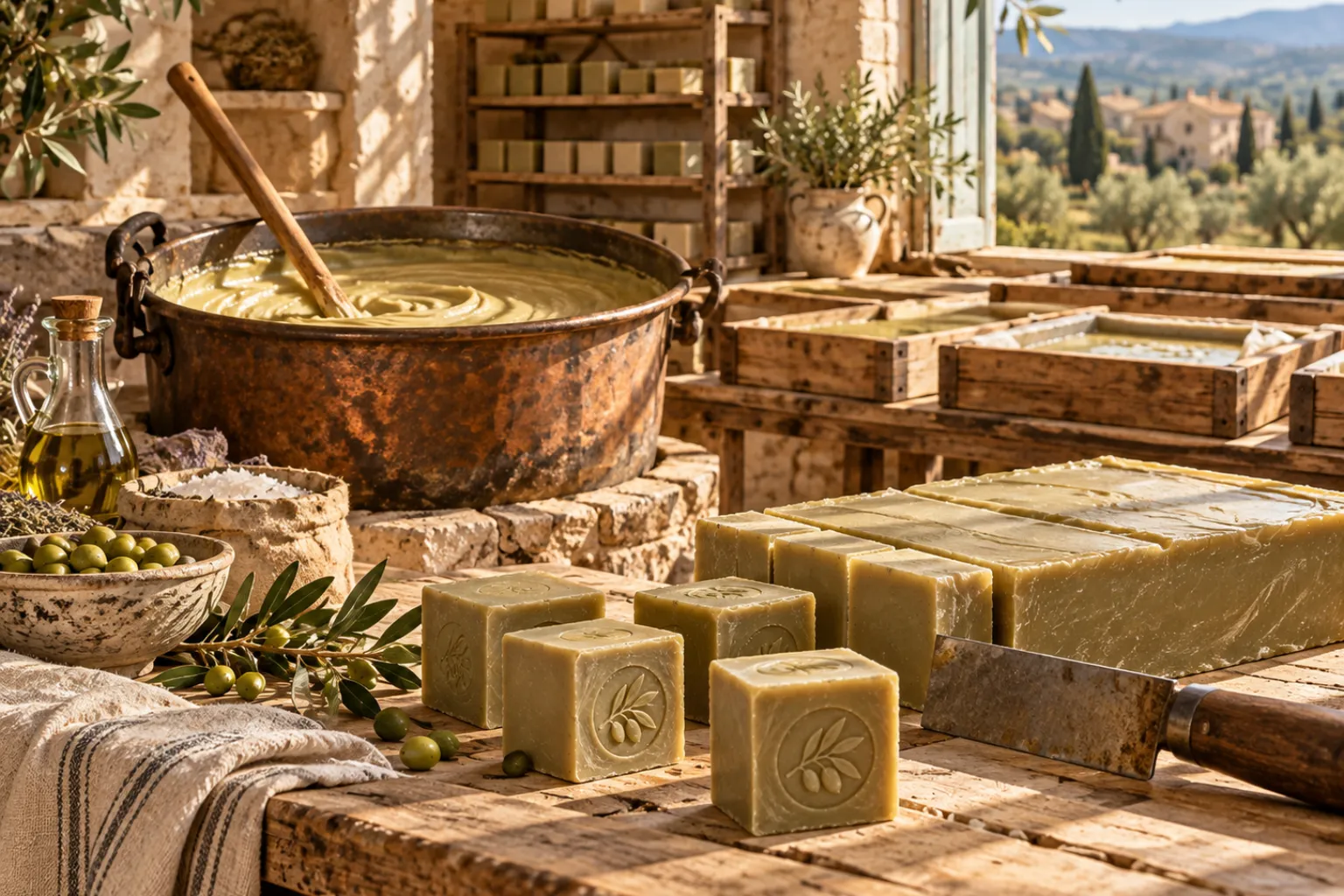
What really defines Marseille soap is how it's made. In the traditional process, oils and alkali are cooked together in very large kettles over several days. The soap is washed repeatedly with salt water to separate it from the excess lye and glycerin, then poured, dried, cut into cubes and stamped on the sides. A classic cube is stamped "72%", the share of oil in the recipe.
Green or white
The traditional cube comes in two colors. The green one is made with olive oil. The white or ivory one, which became common in the 20th century, is made with other vegetable oils such as palm and coconut. Neither has added fragrance or color.
Not a protected name
Savon de Marseille is not protected by an official origin label, unlike French cheeses or wines. Bars sold under that name can be made anywhere, by any method. Only a handful of soap makers still cook it the old way in the Marseille area. If the real thing matters to you, look for the cooking method, the oil content and the place of manufacture on the label.
How French homes use it
Marseille soap is a working soap. French homes keep a cube for hand washing at the sink, for rubbing on stains before laundry, and for general cleaning. It has a plain, clean smell and no perfume.
Castile vs Marseille, side by side
| Castile soap | Savon de Marseille | |
|---|---|---|
| Origin | Castile, Spain | Marseille, Provence, France |
| Defined by | The oil: olive oil | The method: kettle cooked, salt washed |
| Main oils | Olive oil, sometimes others today | Olive oil (green) or other vegetable oils (white) |
| Usual form | Bar or liquid | Cube, stamped |
| Scent | Often unscented, some with essential oils | Unscented |
| On the label | Sodium olivate or potassium olivate | Sodium olivate (green), or sodium palmate and cocoate (white) |
For more on reading INCI names like these, see soap ingredients explained.
Where scented French bars fit in
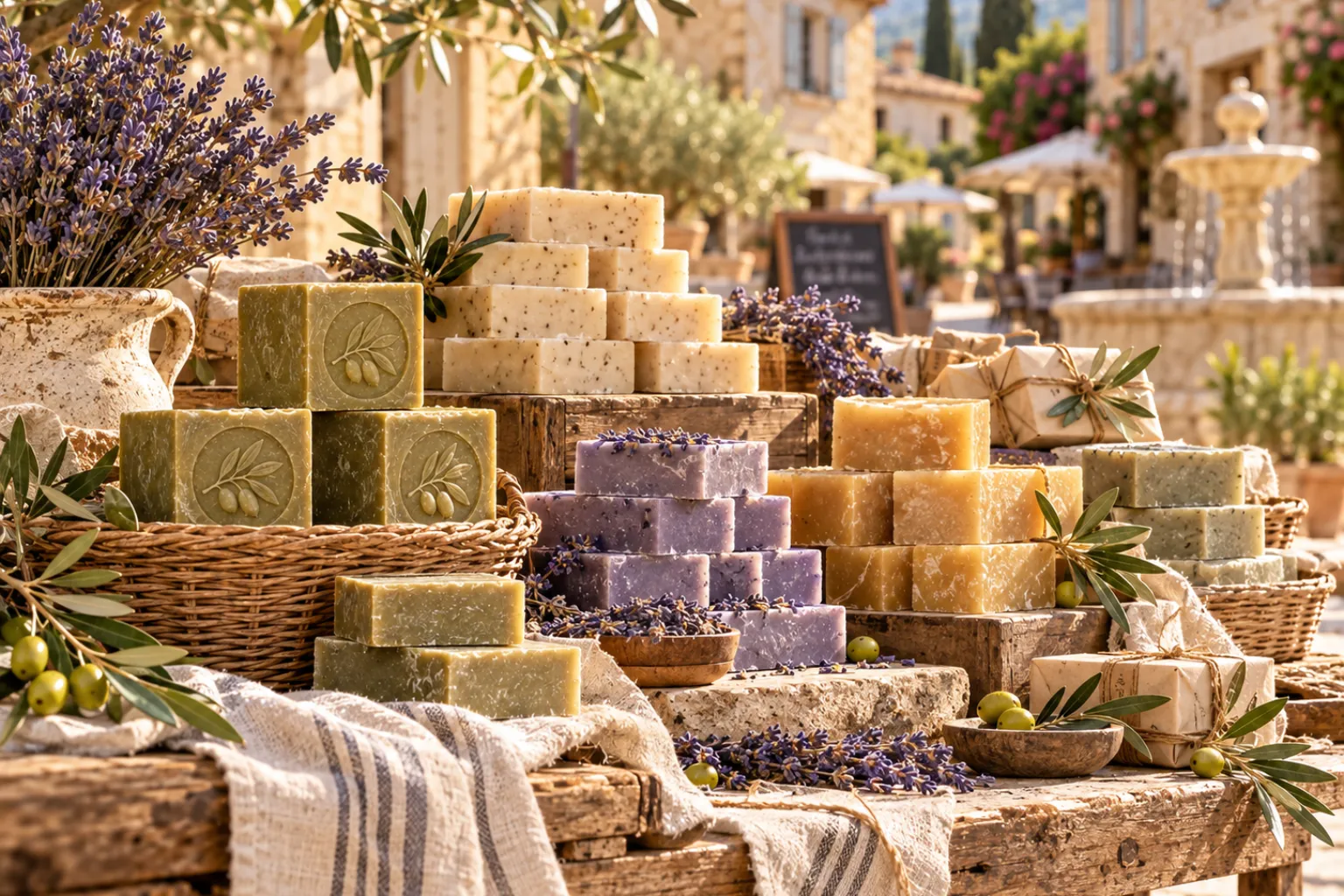
When people buy soap in Provence, though, they mostly bring home neither of these. They bring home the scented bars: lavender, verbena, fig, orange blossom. These are a third kind of French soap, made to be used and smelled every day.
That is what we sell. Our bars are made in Provence, France, with AOP olive oil. To be clear about what's inside: their base is sodium palmate and sodium palm kernelate, with shea butter, glycerin, olive oil, fragrance and colorants. So they are not Castile soap and not Savon de Marseille, and we don't sell either on this site. Every soap page lists its bar's full ingredients.
The palm based recipe gives a hard bar with a fuller lather than a pure olive oil soap, and it holds a scent well. If you like the plain, quiet character of Castile or Marseille soap, a few of our bars come close in mood:
- Olive Oil: green and fresh, more leaf than fruit.
- Shea Butter and Milk: soft, creamy, barely there.
- Donkey Milk: a very light scent with nothing loud in it.
- Lavender Olive: the classic Provence pairing.
Our guide to French soap from Provence covers the scented tradition in more detail, and How soap is made explains the cold process, kettle and milled methods behind each kind of bar.
Which should you buy?
- You want plain olive oil soap: look for a bar whose first ingredient is sodium olivate, whatever it's called on the front.
- You want a traditional Marseille cube: look for kettle cooking, 72% oil and a maker in the Marseille area.
- You want a bar that smells like Provence: choose a scented French bar, and pick by scent. Any 4 of ours are $29.95, and any 8 are $54.95 with free shipping.
Questions
What is Castile soap?
Originally, a hard soap made mostly or entirely from olive oil, named after the Castile region of Spain. Today the name is used loosely, including for liquid soaps and for soaps made from other plant oils, so check the ingredient list to see what you are getting.
What is the difference between Castile soap and Marseille soap?
Castile soap is a Spanish tradition defined by olive oil. Savon de Marseille is a French tradition defined by its method: oils cooked in large kettles over several days and washed with salt water. The green Marseille cube is made with olive oil, and a white version uses other vegetable oils.
Is Castile soap the same as olive oil soap?
In the traditional sense, yes. A classic Castile bar is olive oil soap. On a label you will see it as sodium olivate. Many modern 'Castile' products add coconut or other oils for more lather.
What does 72% mean on Marseille soap?
Traditional Savon de Marseille is stamped '72%', the share of oil in the recipe. It's a mark of the classic formula, not a legal guarantee, since the name Savon de Marseille isn't protected by an official origin label.
Are Savon's bars Castile or Marseille soap?
No. Ours are scented French bars made in Provence with AOP olive oil, on a base of sodium palmate and sodium palm kernelate with shea butter and glycerin. We don't sell Castile or Marseille soap on this site.