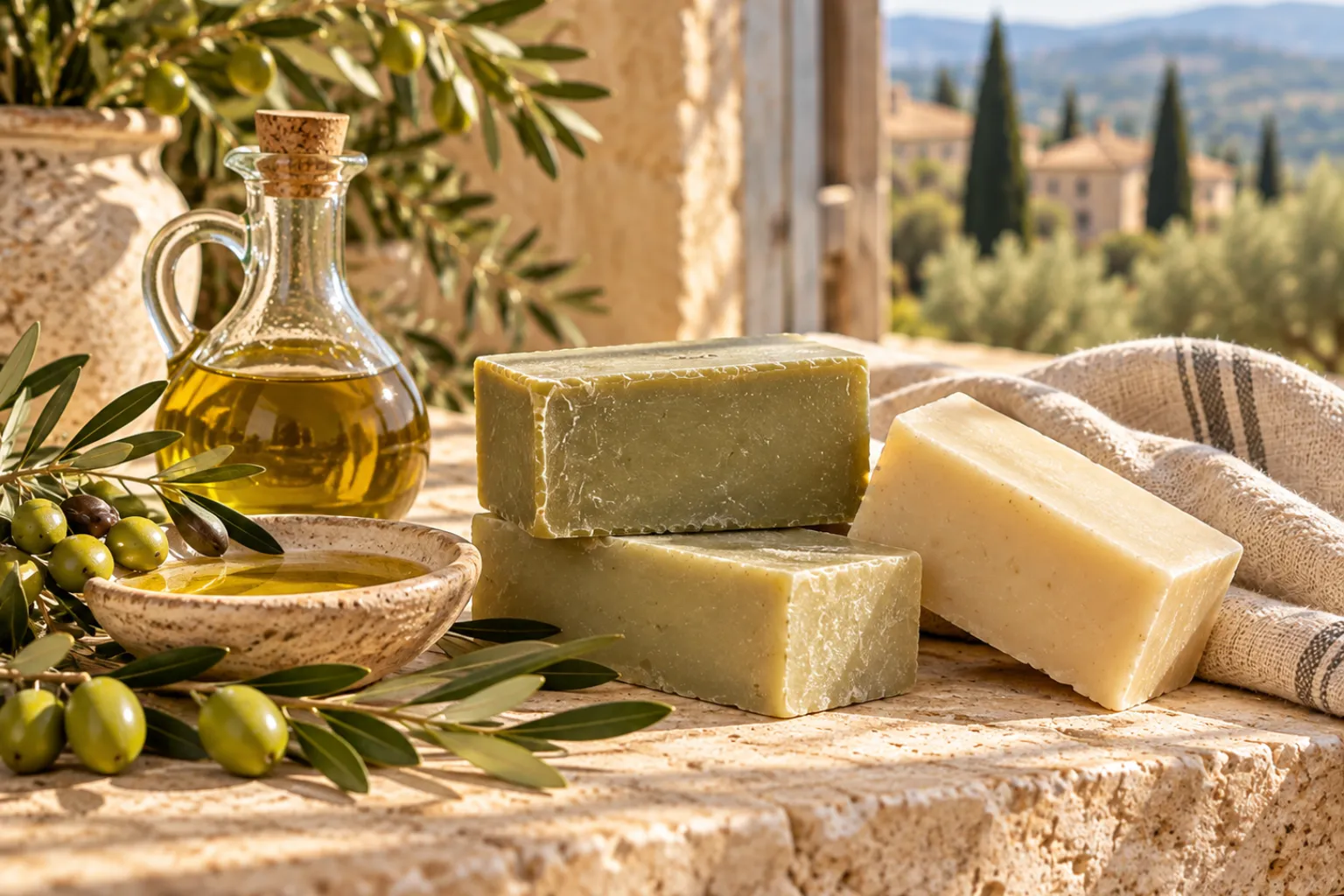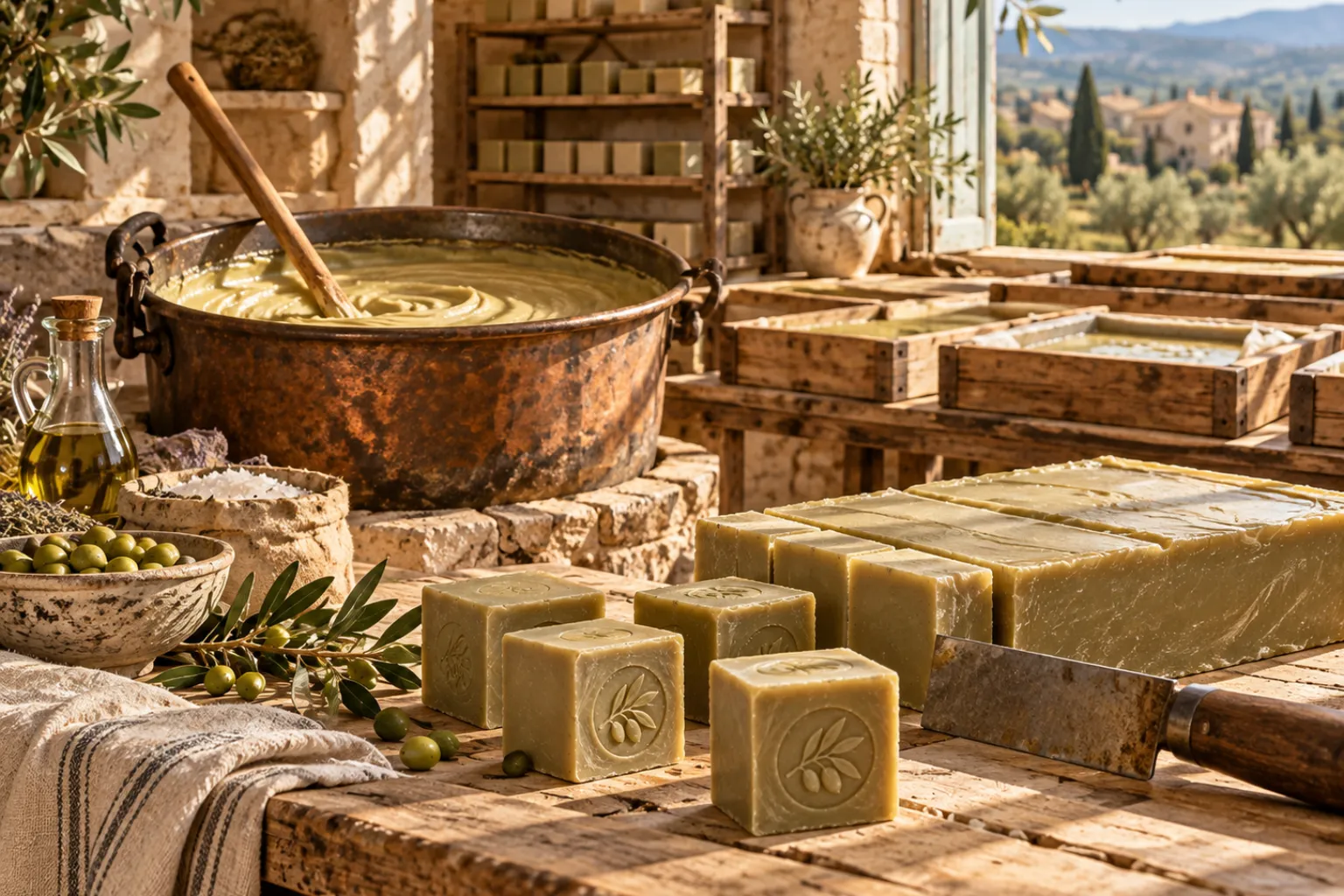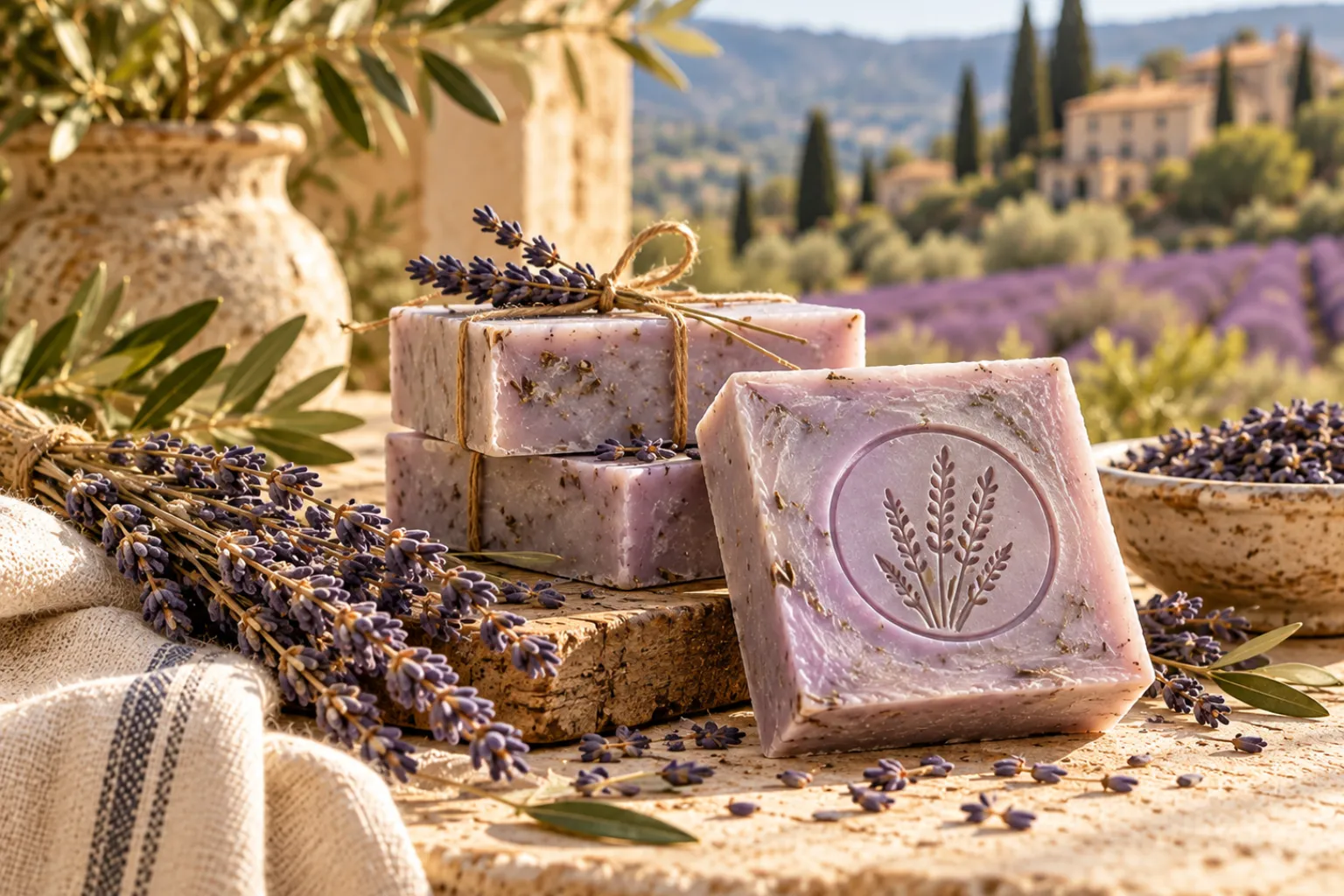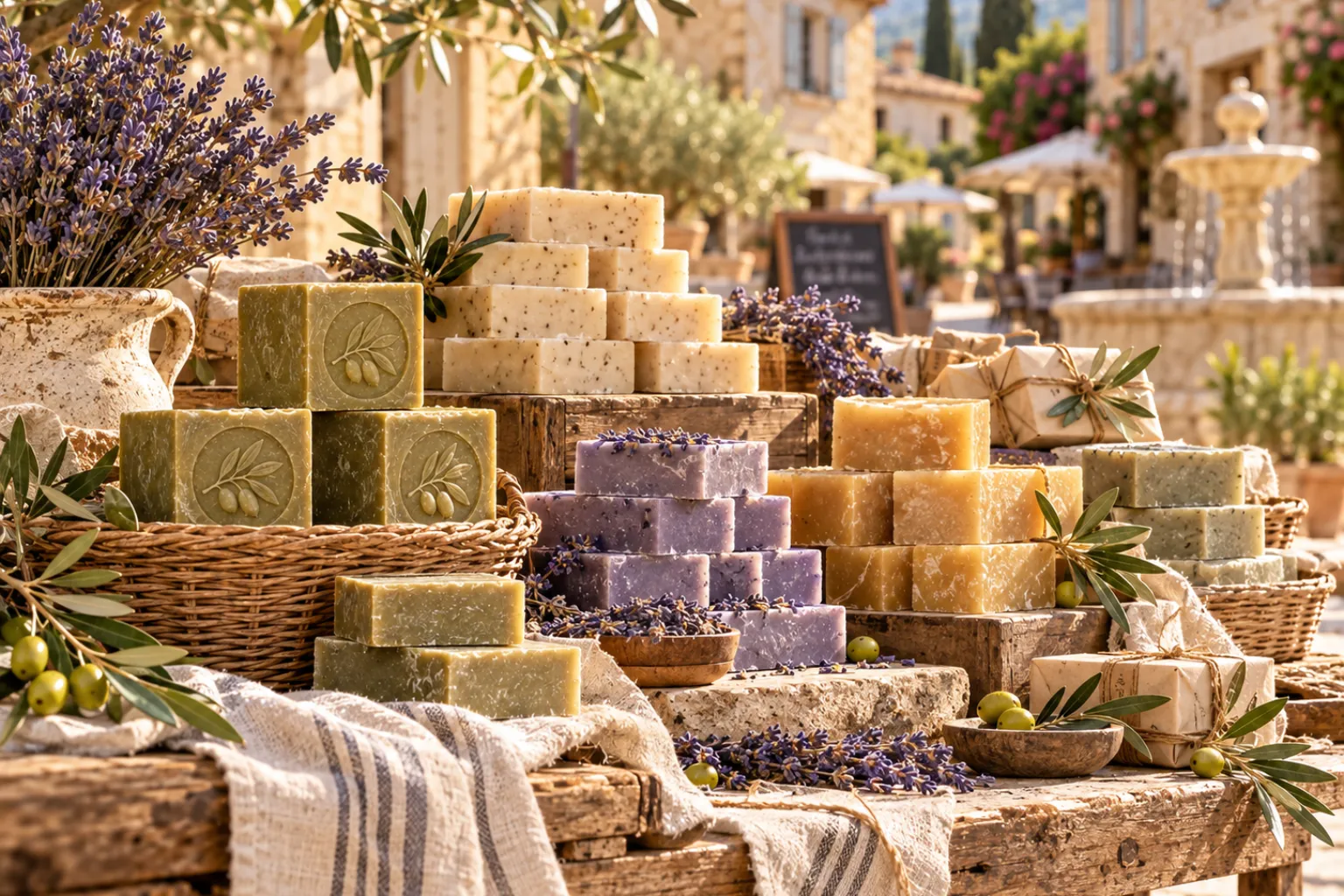
Walk through any market in the south of France and you'll find a table of soap: stacked bars in lavender, cream and olive green, a few cut open so you can smell them. French soap from Provence is an everyday thing there, as ordinary as bread. This guide explains what it actually is, where the tradition comes from, and how to tell a real French bar from one that only borrows the look.
What people mean by "French soap"
There is no legal definition of French soap. In practice, people use the term for a solid bar made in France, most often in Provence, with a few things in common:
- A hard, dense bar. French bars tend to feel heavy in the hand and wear down slowly.
- Olive oil in the recipe. The south of France is olive country, and olive oil has been part of its soap for centuries.
- A clear, lasting scent. Lavender, verbena, orange blossom, fig and fresh herbs, the smells of the region.
- Simple presentation. A stamped name, maybe a paper wrap, nothing fussy.
That last point matters more than it sounds. A French bar is meant to sit out on a sink and be used every day, not saved in a drawer for a special occasion.
A short history of soap in Provence
Soap making around the Mediterranean grew up where olive trees did. Aleppo in Syria, Nablus, Castile in Spain and Marseille in France all developed their own olive oil soaps. Marseille had a port, olive oil from Provence and soda ash from coastal plants, so by the Middle Ages it was already a soap town.
In 1688, an edict under Louis XIV set rules for soap made in Marseille, including that it be made with olive oil. By the 1800s the city had dozens of soap works shipping bars across Europe and its colonies. That reputation is why "soap from Provence" still means something to people who have never been there.
Over time, the region's soap makers also began making scented bars, using the lavender, herbs and flowers that grow around them. Those scented bars are what most visitors bring home today. If you want the full story of the plain Marseille cube and how it compares with Spanish Castile soap, read Castile soap vs Marseille soap.
What goes into a bar
All true soap starts the same way: oils or fats react with an alkali and become soap and glycerin. What changes from bar to bar is the choice of oils, what's added at the end, and how the bar is finished. We go through the process step by step in How soap is made.
Here's what our own bars contain, so you know exactly what you're buying. Their base is sodium palmate and sodium palm kernelate, the soap made from palm and palm kernel oils. That base makes a firm bar with a steady lather. On top of it come shea butter, glycerin, olive oil, fragrance and the colorants for each scent. Some bars add a little extra: ground rose petals, kaolin clay or herb pieces for texture.
Two things our bars are not. They are not Castile soap, which is made mostly from olive oil. And they are not Savon de Marseille, which is a separate, unscented tradition. They are classic scented French bars, made in Provence with AOP olive oil. AOP is France's protected designation of origin, the same system that protects Champagne and Roquefort.
The scents of the south
If you've been to Provence in summer, you already know the palette. These are the scents French soap is best known for:
| Scent | What it smells like | Try |
|---|---|---|
| Lavender | Clean, dry, a little herbal, like a linen closet sachet | Lavender, Lavender Olive |
| Verbena | Bright lemony leaves, fresh and green | Verbena, Lemon Verbena |
| Olive | Green and quiet, more leaf than fruit | Olive Oil |
| Herbs | Thyme, rosemary and savory in the sun | Herbes de Provence Scrub |
| Orange blossom | White flowers with a hint of citrus peel | Orange Blossom |
| Mimosa | Soft, powdery yellow blossoms of late winter | Mimosa |
| Anise | Licorice and herbs, like a glass of pastis | Pastis Anise |
For a wider tour of scent families, from citrus to woods to soft musks, see our soap scent guide. Lavender gets its own page too: all about lavender soap.
French soap vs "French-style" soap
Because French soap has a good name, a lot of soap is sold with a French look: a script font, a few words in French, a picture of lavender. Some of it is made in France and some isn't. A few things help you tell:
- Read the origin line. "Made in France" is a statement of origin. "French formula", "French style" or "inspired by Provence" is not.
- Read the ingredient list. A real bar lists its ingredients in INCI names, the standard international names. If you can't find a list, ask the seller.
- Be careful with big claims. "Pure olive oil", "triple milled" and "authentic Marseille" are all specific claims. A seller who uses them should be able to back them up with the ingredient list.
We try to make this easy. Every soap page on our site shows the full ingredient list for that bar, and we say plainly what our bars are and aren't.
How the French use their soap
In a French home, bar soap is everywhere: a lavender bar by the bathroom sink, a citrus or herb bar at the kitchen sink, something soft in the shower, a bar tucked in a drawer to scent the linens. People pick scents the way they pick flowers, by room and by season.
That's the easiest way to start, too. Pick a few scents for different spots in the house and see which ones you reach for. With 86 scents, it helps to try a mix rather than commit to one.
How to choose your first French bars
- Start with one classic. Lavender or Verbena is the scent most people think of when they think of Provence.
- Add something fresh for the kitchen. Citrus and herbs are easy at the sink. Browse the citrus and herbal bars.
- Add something soft or warm. A quieter bar is nice in the shower or guest bath. See the soft and sweet families.
- Keep it dry. A French bar lasts longest on a dish that drains. Our guide on making bar soap last covers the details.
Each bar is 4.4 oz. A single bar is $8.95, any 4 are $29.95, and any 8 are $54.95 with free shipping. You can mix any scents, doubles included. Read more about us on the about page, or start picking in Build your set.
Questions
What is French soap?
In everyday use, French soap means a solid bar made in France, usually in the south, often with olive oil and a clear, lasting scent. Some bars are made in the old Marseille tradition, and many scented bars are milled, which gives them a hard, smooth, even texture.
Why is soap from Provence famous?
Provence has olive groves, lavender fields and a soap making history that goes back centuries, centered on Marseille. A royal edict in 1688 set rules for soap made there, and the region's bars became known across Europe.
Is French soap the same as Marseille soap?
Not always. Savon de Marseille is one specific tradition: a plain, high oil soap cooked in large kettles, usually sold as an unscented green or ivory cube. Most scented French bars, including ours, are a different kind of soap.
How can I tell if a bar is really made in France?
Look for a clear 'Made in France' statement and a full ingredient list. Words like 'French style', 'French formula' or 'French inspired' don't tell you where the bar was made.
Where are Savon's bars made?
Every bar is made in Provence, France, with AOP olive oil. Each soap page lists that bar's full ingredients.